Research Institutes & Think Tanks · St. Petersburg
USGS St. Petersburg Coastal and Marine Science Center
- Since
- 1989
- Location
- St. Petersburg
- Languages
- English
Story
Overview
The U.S. Geological Survey's St. Petersburg Coastal and Marine Science Center investigates processes in coastal and marine environments and their societal implications for natural hazards, resource sustainability, and environmental change. Its research covers coastal erosion, storm impacts, coral reefs, wetlands, and barrier islands. Today the center has more than 100 staff members — biologists, oceanographers, data modelers, remote sensing specialists, biogeochemists, microbiologists, coral reef experts, marine operations crew, and more — working across 57,000 square feet of labs, offices, and workspace in the St. Petersburg Innovation District.
How the USGS Came to St. Petersburg
In 1987, the USGS began searching for a location for a new Center for Coastal Geology. The University of South Florida College of Marine Science submitted a proposal, backed by the St. Petersburg Progress group (now the St. Petersburg Downtown Partnership), which saw the center as a cornerstone for revitalizing the area. After visiting four sites along the East Coast in early 1988, a 10-member USGS selection committee voted unanimously for St. Petersburg, in part because of the strong support of the local community and the USF College of Marine Science. The first six staff members worked from a former podiatrist's office downtown until their new home was ready.
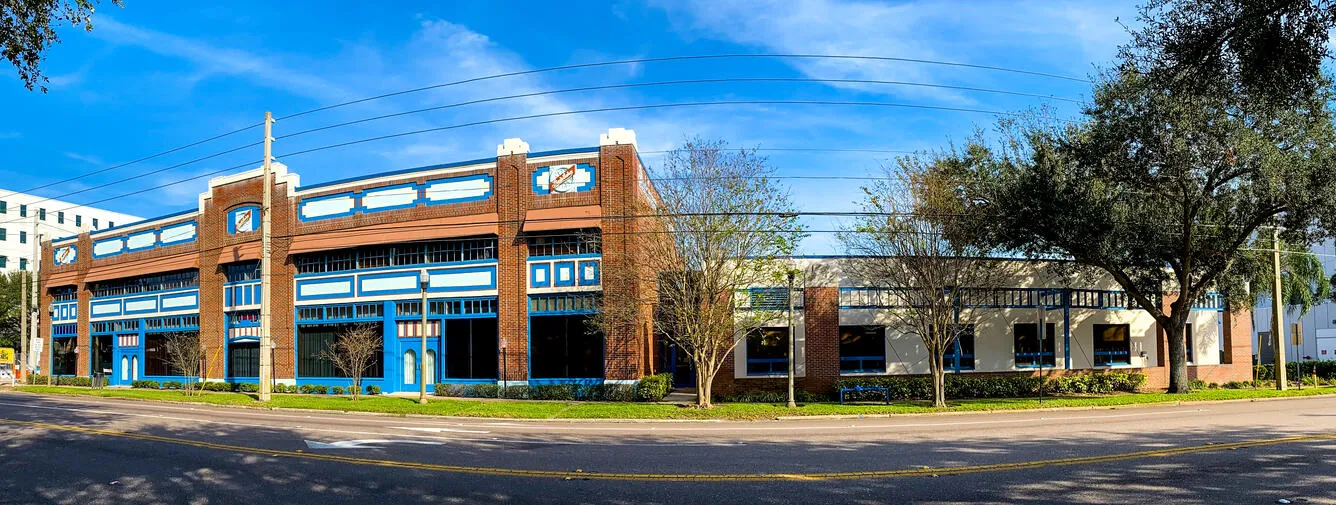
The Studebaker Building
That home is the historic Studebaker Building. Built in 1925, it was financed by Frank Lyon and leased to the Peninsular Motor Company of Southwest Florida as a Studebaker dealership and repair shop — the fourth-largest Studebaker dealer of the 1920s — before closing during the Great Depression. Cars were displayed on the tiled showroom floor behind large storefront windows, while the repair shop upstairs was reached by a large industrial car lift. The building later housed a grocery store, a laundromat, and a cigar company. It was listed on the National Register of Historic Places on July 5, 1985, and the "Studebaker Distributors" sign and stucco wagon-wheel logos still decorate its facade. The renovated building was dedicated as the USGS center in June 1989.
A Growing Campus
By 1995 the staff had grown to about 60, and a second building opened on May 8, 1996, with a sediment and coral laboratory, core archive space, and field staging areas. It was named for Paul L. Getting, executive vice president of the St. Petersburg Chamber of Commerce, whose efforts helped bring the USGS to the city. A third building, with six laboratories, a dive locker, and 12 offices, was dedicated in March 2008 as part of the C.W. Bill Young Marine Science Complex — a cooperative venture that includes the USF College of Marine Science, the Florida Fish and Wildlife Research Institute, the Tampa Bay Estuary Program, NOAA Fisheries, Florida Sea Grant, Eckerd College, and the Florida Institute of Oceanography.
The center is a research facility and is not set up as a visitor attraction; its science is shared with the public through data, maps, publications, and a monthly seminar series.
Products & services
Coastal & Marine Research
Research on coastal erosion, storm impacts, coral reefs, wetlands, barrier islands, and climate change reconstruction.
Coastal Change Forecasts
Forecasts of storm-driven overwash and inundation, and training for the National Weather Service on total water level and coastal change forecasts.
Data, Maps & Web Tools
Public scientific data, maps, and web tools.
Publications
Peer-reviewed research authored by center scientists.
Science Seminar Series
Seminars on the third Tuesday of each month.
Multimedia & Virtual Tour
Photos, videos, a virtual tour of the center, and an interactive geonarrative on its research and history.
Sound Waves Newsletter
A newsletter featuring coastal and ocean science from across the USGS.
Location
600 4th Street South, St. Petersburg, FL, 33701
Get directions